
Are Payday Loans Legal in Ontario? Costs, Limits & Safer Alternatives
Payday loans are legal in Ontario but tightly regulated. As of 2026, lenders can charge max $14 per $100 borrowed and must be FSRA-licensed. You can’t borrow over 50% of net income, rollovers are banned, and there’s a 2-day free cancellation period. If you miss payment, up to 2.5% monthly interest applies. This guide explains the rules and safer alternatives like bank loans, LOCs, and fintech options.

Written by
Lucas Pentland-HydeUpdated on
February 20, 2026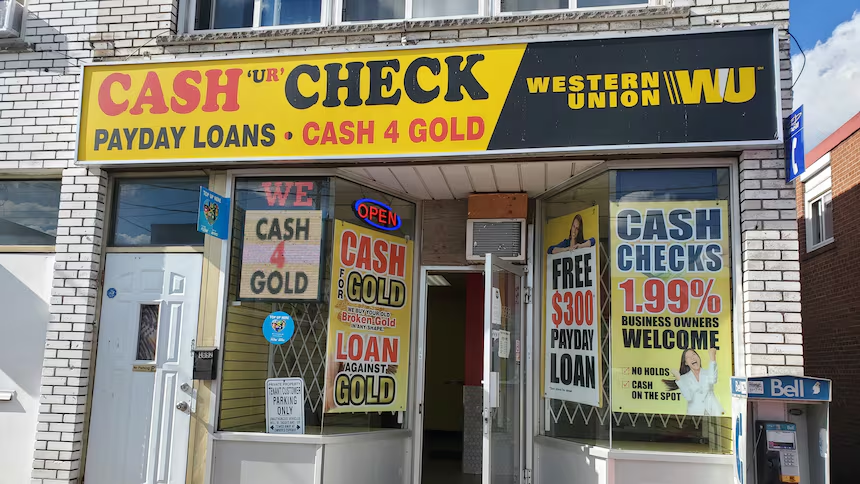
Ontario Regulations: Who Can Lend, and Under What Rules
In Ontario, only licensed lenders may offer payday loans. These lenders must comply with the Payday Loans Act and Ontario Regulation 366/09 (amended periodically). Key legal rules include:
Maximum Cost: Ontario caps borrowing costs at $14 per $100 advanced. (Note: Ontario’s older law had $15/100, but since Jan 1, 2025 federal criminal‑rate regulations enforce $14/100 in all provinces.) In advertising and contracts lenders must disclose the fee per $100 and the equivalent APR. For example, a $500 loan costs up to $70 interest (14% of $500) due in ~14 days.
Loan Limits: The maximum payday loan in Ontario is $1,500 or 50% of your net monthly income, whichever is lower. Lenders cannot issue a payday loan exceeding half of your take‑home pay. (If you need more money, other credit forms must be used.)
Term Limits: Payday loans must be short-term. The law requires a minimum term of 5 days and a maximum of 62 days. Typical terms are 14–30 days (often your next payday). A longer term reduces allowed interest, but few payday loans exceed 2 months.
No Rollovers: Ontario bans rollovers or repeated short-term renewals. You must repay the loan in full by the due date. However, under an extended payment plan (see below) you can repay in installments. For borrowers who take three payday loans within 63 days, lenders must offer an extended payment plan option (more on this below). In any case, lenders cannot simply roll over or add more loans to cover unpaid balances.
Cooling-Off Period: You have a right to cancel a payday loan within 2 days of signing (no reason needed and no cancellation fee). This 48‑hour “cooling-off” period is mandatory by law. To cancel, you typically must notify the lender in writing and repay the principal (no interest) to trigger the refund of fees.
Disclosures: Lenders must provide a written contract showing all details: amount, fees, due date, APR, etc. They must also display APR rates in marketing.
Complaints: Payday lenders are regulated by Consumer Protection Ontario (via FSRA). Violations (e.g. charging more than $14 per $100) can be reported to FSRA or the Ministry of Government and Consumer Services.
Maximum Cost Per $100 Borrowed
Ontario’s cost cap is $14 per $100 borrowed. In practice, this means a $500 loan has a $70 maximum fee. This high fee translates to about 365% APR for a 14‑day loan. Importantly, the federal Criminal Interest Rate Regulations (2024) set $14/100 as a cap in all dprovinces with payday regimes. No lender may charge more than this. For example: a $1,000 payday loan in Ontario has a maximum total cost of $140. Any advertised fee above $14/100 is illegal (and illegal to advertise). By law, lenders must show the APR on the contract or disclosure.
Borrowed | Max Fee | Total Due | APR (approx.) |
|---|---|---|---|
| $100 | $14 | $114 | 365% (14 days) |
| $500 | $70 | $570 | 365% (14 days) |
| $1,000 | $140 | $1,140 | 365% (14 days) |
This table illustrates the cap. (Some lenders quote slightly lower fees, e.g. $13/100, effectively lower APR.) If a lender advertises a fee higher than $14/100, they are violating Ontario law.
Rollover and Payment Plan Rules
Ontario law prohibits rollovers (renewing one payday loan into another). Instead, the law requires that by the third loan within a 63-day span, lenders offer an extended payment plan. In practical terms: if you take out three payday loans within 9 weeks, the lender must let you repay in installments. Under this plan, you can repay the principal and interest in 3 equal installments (if paid weekly/biweekly) or 2 equal installments (if paid less frequently). For example, someone paid monthly would spread repayment over at least two pay periods, paying up to 50% of the balance each time. You may exit the plan at any time without penalty. Prepayments are allowed anytime at no extra cost. If you do not qualify for an extended plan or choose not to use it, you must repay your payday loan in one lump sum by the due date. After that date, the loan is in default (see below).
Cooling-Off Period (Cancellation)
Ontario provides a 48-hour cooling-off period after signing a payday loan. You can cancel the loan (for a full refund of fees) any time within two business days. No reason or fee is required to cancel. You simply notify the lender (often in writing or registered mail) that you are cancelling. Lenders must then refund any fees you paid. This right is mandated by the Consumer Protection Act for payday agreements. (By contrast, most other contracts allow a 15-day cancellation period, but payday loans get a shorter 2-day window due to the speed/nature of the product.)
If You Can’t Repay on Time
If you miss the due date and can’t fully repay your payday loan, Ontario law limits what the lender can do:
No New Loan: The lender cannot issue you another payday loan until the current one is fully repaid. You cannot “rollover” the debt by taking a new loan to cover the old one.
Late Fees: The lender can charge up to 2.5% interest per month on the overdue balance (this is 30% APR). They may also charge NSF fees on any bounced payment, but these are capped (e.g. max $12.50 NSF fee under Canadian law).
Collections & Legal: If you default, the lender may refer the debt to collections or sue you in Small Claims Court. They must follow Ontario collection rules (e.g. no abuse or excessive phone calls).
Partial Repayment Allowed: You are allowed to make partial payments on the loan at any time. Even paying part of the balance early can reduce the total interest owed.
Rights Advice: If you cannot repay, you should contact a non-profit credit counsellor or legal clinic rather than resort to new costly loans. Ontario also prohibits lenders from harassing you beyond reasonable limits (no calls at odd hours, no third-party contacts, etc.).
Comparison of Payday Loans and Alternatives
Option | Cost (APR) | Typical Term | Max Amount | Prepay/Rollover | Best For |
|---|---|---|---|---|---|
Licensed Payday | $14/100 (≈365% APR) | 14–28 days (max 62) | $300–$1,500 | No rollover; (3 loans triggers extended plan) | Immediate small emergencies (no credit check) |
Bank LOC (unsecured) | Prime+ ~1–3% (≈5–8%) | Revolving (no fixed term) | $5,000–$50,000+ | No rollover (interest only on used portion) | Flexible borrowing; lower rate (requires credit) |
HELOC (home-secured) | Prime+ ~0.5–1% (≈5–7%) | Revolving (open-ended) | Up to ~80% of home value | No rollover (interest-only min payments) | Large expenses (secured by home; cheapest money) |
Credit Card | ~19–24% (purchases) | Revolving (no term) | $5,000–$25,000+ | No rollover (min payment required) | Everyday purchases (0% promos); high convenience |
Peer-to-Peer Loan | ~8.99–34.99% | 3–5 years (fixed) | $1,000–$35,000 | No rollover (fixed payment schedule) | Fair credit borrowers; debt consolidation |
Fintech Loan | ~9.99–35.95% | ~6 months–7 years | $300–$35,000 | No rollover (fixed repayment terms) | Fast online approval; riskier credit profiles |
(APR figures are illustrative ranges. Payday loan APR assumes 2-week term.)
The chart above highlights that payday loans are by far the most expensive form of credit (365% APR). Traditional credit options like lines of credit or credit cards have APRs typically in the single digits to low 20s (Revolving LOCs often run prime+1–3%, credit cards ~19–24%), making them cheaper for those who qualify. Home equity credit (HELOC) is the cheapest since it’s secured. Peer-to-peer and fintech loans sit in between – they may be accessible with fair credit but charge ~9–35% APR.
Safer Alternatives to Payday Loans
If a payday loan’s cost is unacceptable or not needed, consider these alternatives:
Personal Lines of Credit (LOC): Unsecured LOCs from banks/credit unions offer variable rates (prime+1–3%). You borrow only what you need and pay interest on that amount. Lines of credit have no fixed term (like a credit card) but generally much lower interest than a payday loan. Good for ongoing cash needs.
Home Equity Line of Credit (HELOC): If you own a home, a HELOC provides very low interest (prime+0.5–1%). It offers a large credit line. You make interest-only payments for a draw period, then repay principal. Although there are setup costs (legal fees), the APR is a fraction of a payday loan. Best for major expenses if you have equity. However, default risks losing your home.
Credit Cards: For smaller needs, credit cards often have 0% introductory offers or lower fixed promotional rates. Regular APRs (~19–24%) can still be cheaper than a payday loan. Avoid if you can’t pay at least the minimum due; but if you only need short-term credit and can repay in a few months, cards can be a lower‑cost option. Many cards have no annual fee.
Installment Loans: (Not payday) Banks and online lenders offer personal loans up to $20,000+ with fixed APRs (often 6–14% for good credit). These are repaid over years in set payments. If you need more than $1,500 and have decent credit, a small personal loan is far cheaper than a payday loan. Avoid predatory online loans.
Peer-to-Peer Lending: P2P platforms like goPeer match you with private investors. APR ranges from about 8.99% up to ~34.99%. Terms are typically 3–5 years. There is an origination fee built into the rate. Funding can take several days. Good for fair-credit borrowers looking for lower rates than payday loans.
Fintech / Alternative Lenders: Online lenders (Spring Financial, easyfinancial, etc.) provide quick small loans ($300–$35,000). Their APRs vary widely (often 9.99%–34.95%). Approval and funding are fast (sometimes same-day). They have no prepayment penalties. Use them only if you have no bank alternatives and need cash urgently. Always compare rates first.
Borrowing from Friends/Family: If possible, borrowing informally at 0% interest is ideal. However, treat it as a formal arrangement to avoid conflicts.
Financial Assistance: For emergency needs (rent, utilities), seek Ontario benefits or charities (e.g. Ontario Works, Salvation Army funds) before taking high-cost loans.
Each alternative has pros and cons. Consider all available options, including delaying non-urgent expenses, before resorting to a payday lender.
How to Apply and Checklist
If you do proceed with a payday loan, follow these steps carefully:
Compare Lenders (Licensed Only): Make sure the lender is licensed (check FSRA or Ontario Consumer Protection lists). Compare fees: some lenders may charge exactly $14/100, others slightly less (e.g. $13/100).
Gather Documents: Ontario lenders typically require two pieces of ID (one with photo), proof of income (pay stubs or government benefits for 3 months), a recent bank statement or void cheque, and proof of address. Having these ready speeds approval.
Check Eligibility: Most payday lenders do not require a good credit score, but they will check that you are employed or on assistance long enough (e.g. 3 months). Confirm that your requested amount is ≤50% of your monthly net pay (including interest).
Read the Contract: Verify the total cost and repayment date. Ensure the fee is ≤$14 per $100. Note your repayment date (usually within 2–4 weeks).
Repayment Plan: Decide how you will repay by the due date (most must be paid in one lump sum). If you foresee trouble, ask about the extended payment plan (especially if this is your 3rd payday loan in 63 days).
Automatic Payments: If possible, set up an automatic withdrawal for the repayment to avoid missing the date. Missing the due date triggers late penalties.
Avoid Rollover Loans: Remember you cannot roll over a payday loan in Ontario. If you can’t repay, contact a credit counselor instead of taking a new loan.
Use Cooling-Off Period if Needed: If you change your mind within 48 hours, cancel in writing to get back any fees.
Keep Records: Save the contract and any payment receipts. Ontario law requires the lender to provide these upon request.
Decision Checklist
Have I Explored Cheaper Options? (Credit card, LOC, family, credit counselor)
Can I Afford the Payment? My net pay minus essential expenses should cover the lump-sum due in 2–4 weeks.
Is the Lender Licensed? Check FSRA or Ontario Consumer Protection Ontario to verify licensing.
Am I Clear on Costs? Ensure the fee per $100 ≤ $14. Confirm no hidden fees.
Do I Have Required Documents? (ID, pay stubs, bank info) Ready to submit.
Understand Repayment: I can repay the full amount by the due date. Prepayment is allowed anytime.
Know My Rights: I have 2 days to cancel; no rollover is allowed; I cannot get a new payday loan without repaying.
Before borrowing, also consider seeking budgeting or debt advice (e.g. from community credit counselors). Payday loans are fully legal in Ontario, but only for licensed providers and within these strict rules. This framework protects consumers by limiting cost and predatory practices, while directing borrowers toward safer alternatives whenever possible.